
The East Tennessee College Baseball Pipeline Is Real — If You Know How It Works
Kids from East Tennessee and Southwest Virginia play college baseball every single year. The pipeline exists. But most families don't understand how it actually works, and that gap costs players opportunities they earned.
The East Tennessee college baseball pipeline is not one straight road. It's a web — JUCO, D3, D2, NAIA, and yes, D1. Understanding every lane on that web changes how you develop your kid and how you market him.
Most Parents Are Chasing the Wrong Level
Every family that walks into my facility wants to talk about D1. I get it. But here's what I've watched happen year after year in the Tri-Cities and surrounding region — players who fixated on D1 or nothing missed legitimate scholarship money and playing time at programs that would've been a perfect fit.
There are strong D2 and NAIA programs within two hours of here that produce professional players. There are JUCO programs that have sent kids to Power Five rosters after two years. The East Tennessee college baseball pipeline runs through all of those levels, not just the marquee names you see on TV.
If you're chasing prestige over fit, you're not making a baseball decision. You're making an ego decision. Those rarely end well for the player.
What College Coaches at Every Level Actually Want to See
I've had this conversation more times than I can count with parents sitting across from me. "He has great grades. He's a great kid. He works hard." That's baseline. That's the floor. Every recruited player has those boxes checked.
What separates recruited from overlooked is tools — measurable, trainable, provable tools.
- Velocity. Arm strength is a tool. Pitching velocity is a tool. Both are trained. Coaches have radar guns. They use them. A pitcher who sits 82-84 at 17 has a different conversation than one who sits 87-89. That gap is developable. It's not fixed.
- Exit velocity. Same principle for hitters. A 16-year-old hitting 85 mph off a tee and an 85-year-old hitting 95 mph walk into the same showcase. One gets calls back.
- Command and feel. Velocity without command is noise. Command without velocity is a ceiling. You train both — not one at the expense of the other.
- Athleticism and projection. College coaches recruit what you're going to be, not just what you are today. If your kid is 15, raw, and still growing, that's a conversation worth having with the right coach at the right time.
The Reality of What Freshman Year Looks Like Here
I wrote about this at length before, and I'll say it again here because it matters for how you think about pipeline prep. When local kids step on a college campus for the first time — whether it's a D1 program, a solid D2, or a JUCO — the first thing that hits them is how strong and skilled their teammates are.
There are 60 guys in a fall roster fighting for spots. The competition is sharper than anything they saw in high school. The guys who came in prepared — physically, mechanically, and mentally — competed immediately. The guys who came in hoping their high school reputation would carry them got humbled fast.
The East Tennessee college baseball pipeline doesn't just reward the most talented kid. It rewards the most prepared kid. Those are not always the same person.
How Showcases Fit Into the Pipeline — and How They Don't
Showcase baseball gets oversold to families in this region. Events are expensive. Travel is expensive. And I've watched families spend thousands chasing exposure at events their kid wasn't ready for, then wonder why the phone wasn't ringing.
Showcases are a marketing tool. They work when the product is ready. If your son's tools — velocity, exit velocity, athleticism — aren't where they need to be for the level you're targeting, putting him in front of college coaches early does more damage than good. Coaches remember. They have notes. "Needs development" is a file that follows a kid.
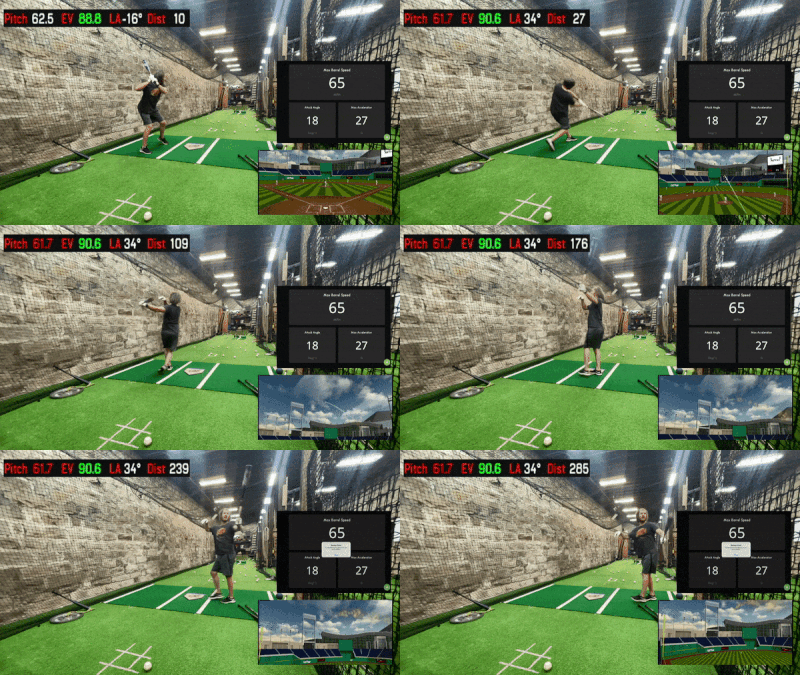
The right sequence is development first, then exposure. Build the tools. Prove them on trackable technology — Rapsodo, HitTrax, a radar gun in the hands of someone who knows what they're looking at. Then step into the right showcase at the right time with a kid who's ready to perform.
What the Tri-Cities and East TN Region Gets Right
I'll give this region credit. The baseball and softball culture here is real. Kids grow up competing. High school programs in this area produce legitimate college players regularly. Coaches in the area care about their kids.
What this region sometimes lacks is access to the kind of data-driven development infrastructure that players in bigger metro areas take for granted. That gap used to cost local kids. It doesn't have to anymore. The tools exist here. The technology exists here. What matters is how you use them — not just throwing a kid in front of a radar gun and calling it development, but building a structured plan around what the numbers tell you.
The college coaches recruiting out of East Tennessee are paying attention to that. When a local kid shows up to a camp or a showcase with documented velocity gains, exit velocity trends, and mechanical footage, that's a different conversation than a kid who just shows up and plays.
Where Local Players Actually Land — and Why
The kids from this region who end up playing college baseball share a few traits. They identified their tools early and worked to develop them. They had realistic conversations about level fit without treating anything below D1 as failure. They stayed healthy — arm care, recovery, workload management wasn't optional for them. And they had someone in their corner who understood both the development side and the recruiting side of this business.
The ones who didn't land somewhere usually fell into one of two traps: they waited on a big offer that never came, or they burned their arm out chasing showcases before their body was ready.
If you want to understand where your son or daughter fits in the East Tennessee college baseball or softball pipeline — and build a real plan to get there — come in and have that conversation. We'll look at the numbers, be honest about the tools, and map out a path that's actually built for your kid, not some generic template.
Reach out to the Earn It Academy to schedule an evaluation. No hype. No fluff. Just a real look at where your player is and where they can go.