
What Do College Baseball Coaches Look For? Here's the Blunt Truth.
College coaches look at tools first, then they look at whether you can actually play. That order matters, and most families have it backwards.
If you want to know what do college baseball coaches look for, stop guessing and start understanding how they actually evaluate. This isn't about getting your kid hyped — it's about putting them in the right position to be recruited.
Tools Are the Entry Ticket
Before a coach cares about your son's character, his GPA, or how many travel tournaments he's played — they want to know if he has the physical tools to compete at their level. That's not harsh. That's the reality of how roster construction works.
For pitchers, velocity is the first filter. I've said it before and I'll say it again: there's obviously more to pitching in college than velocity, but coaches are 100% going to want to know your velocity floor before anything else. Command matters. Stuff matters. Grit matters. But none of that gets evaluated if you don't clear the velocity threshold for that program's level first.
For position players, the measurable tools are exit velocity off the bat, run times, and arm strength. These numbers tell a coach whether your athlete's ceiling is worth a scholarship investment. If his tools are behind the top prospects at his age and he wants to play college baseball, the priority is closing that gap — not polishing his bunting.
Velocity and bat speed are trainable. That's the part families miss. These are not fixed gifts handed out at birth. They are developed through intentional, structured training — sound mechanics, progressive strength work, arm care, and throwing with real intent. What gets measured gets managed. Get your athlete in front of a radar gun under an experienced eye so you know exactly where he stands and what needs to move.
What Coaches See After the Tools Check Out
Once a coach decides your athlete's tools are in range, the evaluation shifts. Now they're watching how he plays the game. This is where a lot of high-tool guys lose opportunities they should have locked up.
Competitiveness under pressure. Coaches watch body language when things go wrong. Does your kid slump after an error? Does the pitcher's mechanics fall apart when runners are on? Does he compete harder or shrink? This shows up clearly in showcase settings and it gets noticed.
Baseball IQ. Does he know where the play is before the ball is hit? Does the pitcher cover first on a groundball without being coached to? Does the catcher control the run game? High-level coaches are not interested in re-teaching the game to a college freshman. They want players who play with their brain engaged.
Coachability. At showcases and campus visits, coaches give subtle instruction to see how a player responds. If your kid shuts down when corrected or argues technique, that's a disqualifier regardless of his exit velo. Coaches are making a four-year investment. They need to know they can develop the player.
Work habits and lifestyle. This sounds soft until you realize coaches talk to each other, they follow social media, and they ask references. Most players don't hit every day, don't have a detailed throwing plan, skip lifts, and don't prioritize arm care. The athlete who does those things consistently stands out immediately — not because everyone else is bad, but because most aren't disciplined.
The Analytics Layer: What Pitch Data Actually Tells a Coach
At the Division I level and increasingly at D2 and D3, coaches are not just watching. They're measuring. Pitch tracking technology — spin rate, horizontal and vertical break, release point, extension, whiff rate — is now part of how college staffs evaluate pitchers from the high school ranks. A pitcher who understands his own data walks into a recruiting conversation with a completely different level of credibility than one who can only say "I throw 87."
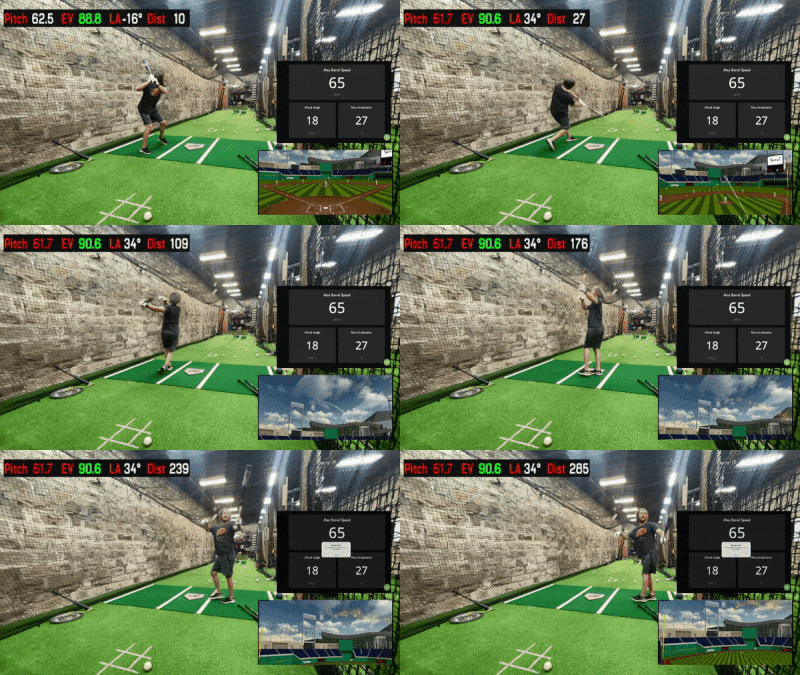
The same shift is happening on the hitting side. Launch angle, exit velocity, spray charts — coaches at top programs pull this data from prospect profiles and event databases before they ever see a player live. If your son's numbers aren't in a system somewhere, he's invisible to a chunk of the market.
This doesn't mean you chase metrics for the sake of having a number. It means you use technology as a diagnostic tool, train to improve the underlying skill, and let the numbers reflect real development. Chasing spin rate without fixing mechanics is just as wasteful as throwing max-effort bullpens without arm care. The data serves the player — not the other way around.
The Academic Side Is Not Optional
A coach who loves your son's tools still can't admit him if he can't get through admissions. And beyond the eligibility floor, coaches want to know you'll handle the academic load of being a student-athlete. They've burned scholarships on guys who couldn't stay eligible. They won't do it twice.
When you go on recruiting visits, ask directly: What does your academic support structure look like for athletes? A program without a real answer to that question is a program that sees athletes as bodies, not people.
What the Recruiting Process Actually Requires From Your Athlete
Here's where I'll be plain with you. College coaches aren't going to come find your kid on their own. The athlete who gets recruited is the one who:
- Has measurable tools that fit the target program's level
- Shows up to the right events in front of the right eyes
- Has a highlight and data profile that gets him in the conversation before the visit
- Handles himself on and off the field like someone who belongs there
- Communicates directly with coaches — not just through a parent or a travel coach
The families who struggle are the ones waiting for a coach to discover their kid. That's not how it works anymore. The recruiting process is a sales process, and your athlete is the product. He has to know his numbers, know his story, and know how to walk into a conversation ready to prove he belongs.
If your son is serious about playing at the next level and you want a clear picture of where his tools stand and what needs to develop before he steps into the recruiting market — reach out. That's exactly what we do.
---
Ready to find out where your athlete actually stands? Get in touch and let's build a plan that puts him in front of the right programs with the right tools to compete.