
Indoor Batting Cages Tri-Cities: Why Winter Is When Hitters Are Made
Winter is not the off-season. It is the season. The players who show up to tryouts in March already ahead of the pack — they didn't get that way by sitting on the couch from November to February. They got their reps in when nobody was watching, usually inside, usually when it was 28 degrees and the fields were frozen solid.
If you're a parent in the Tri-Cities area and you want your kid to actually develop this winter instead of just survive it, you need to understand what consistent access to indoor batting cages Tri-Cities actually does for a player — and what losing those months costs them.
East TN and SW VA Winters Break Routines. Good Facilities Don't Let Them.
Anyone who's tried to practice baseball or softball outdoors in Kingsport, Bristol, or Johnson City between December and February knows the deal. Cold snaps, frozen ground, rain that can't decide if it wants to be sleet. You can't build a consistent swing on a schedule that gets cancelled every other week by the weather app.
Consistency is the whole game when it comes to hitting development. It's not one great session. It's 200 swings on Monday, 200 swings on Thursday, every week, for twelve weeks straight. That's what moves the needle. Weather interruptions don't just delay progress — they erase it. You spend half your next session just getting back to where you were.
That's exactly why having a reliable indoor space matters so much in this region. The Tri-Cities is beautiful country, but it is not kind to outdoor practice schedules in the winter. Players who have access to a dedicated indoor facility — pitching machines, real hitting lanes, climate control — keep building while everyone else is waiting for a dry Saturday
What "Getting Reps In" Actually Means
I hear parents say their kid is "working on their swing" in the winter. When I ask what that looks like, the answer is usually some combination of wiffle balls in the backyard, a handful of tee sessions in the garage, and watching YouTube. That is not a development plan. That is busywork with a bat.
Real development in the winter looks like this:
- Consistent live reps against a machine set at game-speed or faster
- Strength and conditioning work that actually transfers to the plate — lower body, core, rotational power
- Video or coaching feedback so bad habits don't get baked in by repetition
- A training environment with zero distractions and zero excuses
The players I've worked with who make the biggest jumps from one season to the next are not the ones with the most talent. They're the ones who treated winter like a job. They showed up to a real facility, in a focused environment, and put in the work on a schedule
The Cage in Piney Flats: What Members Actually Get
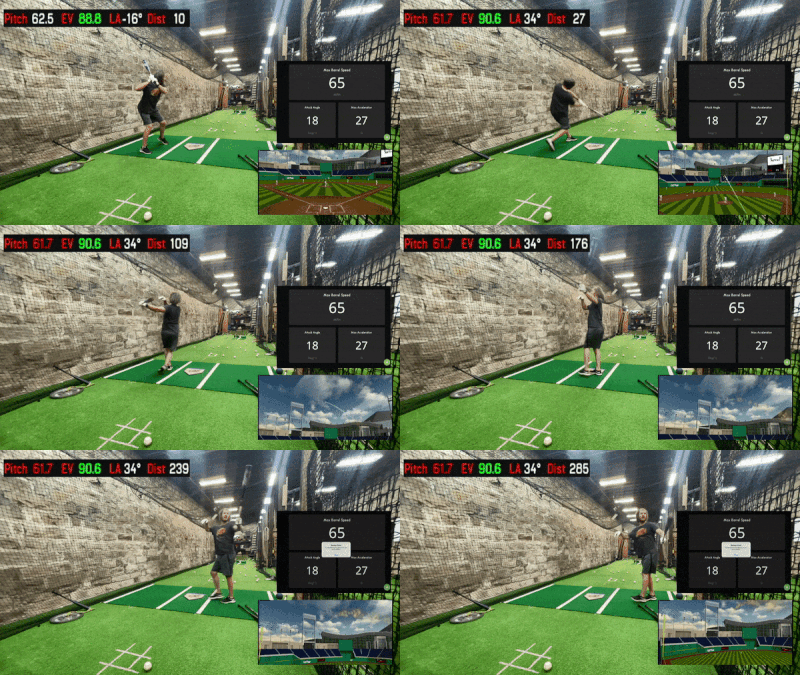
The Cage is not a complicated setup. Nearly 5,000 square feet of indoor practice space. Indoor hitting lanes with pitching machines. A strength and conditioning area. Clean, focused, no-nonsense environment. That's it. That's the point.
The membership gives you flexible access — slots available daily from 7:00am to 9:00pm — so you're not locked into some narrow window that conflicts with school, work, or practice schedules. Families with multiple kids training? There are family options. Teams looking for extra reps outside of games? This is the right place.
What I built at The Cage is the space I wish had existed when I was coming up and working with young players in this area. There is no reason a kid in East TN or SW VA should lose four months of development every single year just because the weather gets cold. The indoor hitting infrastructure that used to exist only at big travel programs or college facilities — that access is now available to local players on a membership basis.
Why Parents Miss This Window Every Year
The biggest mistake I see families make is treating the period between the last tournament and the first spring practice as dead time. The kid played hard all summer and fall, so now they "deserve a break." I get it. Rest matters. Recovery is real.
But there is a difference between a deliberate two-week rest and a four-month disappearance from a hitting routine. One is smart. The other is giving every player who kept working a three-month head start on your kid.
The players who come in for tryouts in March already locked in — they got that way because someone in their corner, usually a parent, refused to let winter become an excuse. They found a facility, they set a schedule, and they showed up. It really is that simple.
The Tri-Cities has the facility. The only question is whether your player uses it.
What to Do Next
If your son or daughter is serious about making a jump this spring — whether that means making a roster, earning a starting spot, or just showing up to the first practice as the best version of themselves — winter access to indoor batting cages in the Tri-Cities is not optional. It's the work.
The Cage at Piney Flats is open. The lanes are ready. The machines are running.
Message us for current availability and membership details, or check the link below to get started. Once you're enrolled, you get a unique door access code and you train on your schedule — no waiting, no weather, no excuses.
The spring roster spots go to the players who worked in the winter. Make sure your kid is one of them.
Ready to get started? Visit linktr.ee/thecagewise or message The Cage directly for current hours, pricing, and availability.
```